Extensions
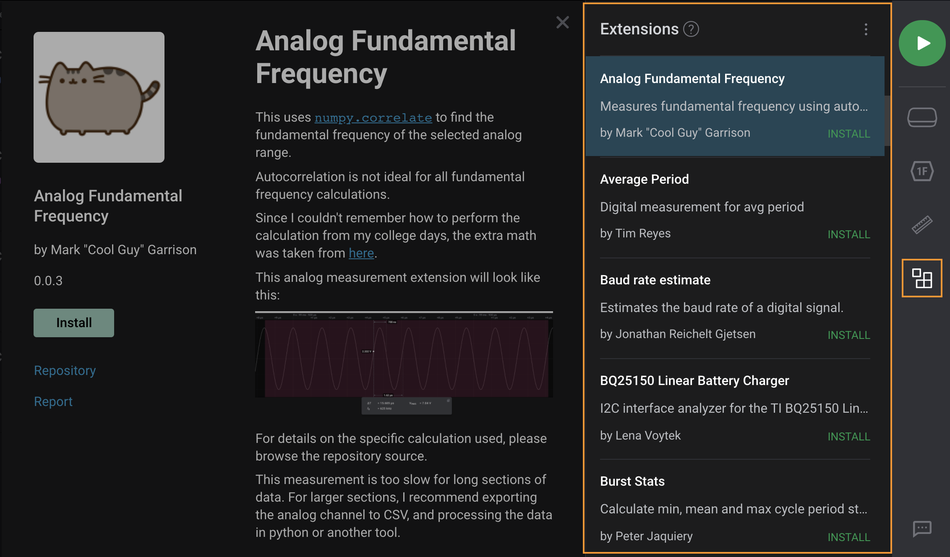
Extensions are Python modules that enhance the debugging process by providing powerful analysis tools on top of your data. There are currently three types of extensions available:
- High-Level Analyzers
- Analog Measurements
- Digital Measurements
You can browse available extensions and install them from the Extensions Marketplace by clicking the Extensions button on the right side of the software. You can also publish your own extensions to the Marketplace.
High-Level Analyzers#
High-level analyzers are protocol analyzers that process the output of the existing "low level" analyzers already in the app. You can write your own in Python, building on top of existing protocol decoders without reinventing the wheel. A common application is converting decoded I2C bytes into clean, device-specific messages so you can read recorded I2C traffic without going back to the datasheet.
See the HLA Tutorial to get started.
Digital and Analog Measurements#
Digital and analog measurement extensions let you write Python code that processes a selected range of analog or digital data and produces metrics. For example, you can compute the jitter in a digital clock signal by iterating over transitions and calculating the deviation from nominal, or measure the RMS voltage of an analog waveform over a selected region. Once written, shift+click a region of a channel and your measurement result appears alongside the built-in measurements.
See the Measurement Tutorial to get started.